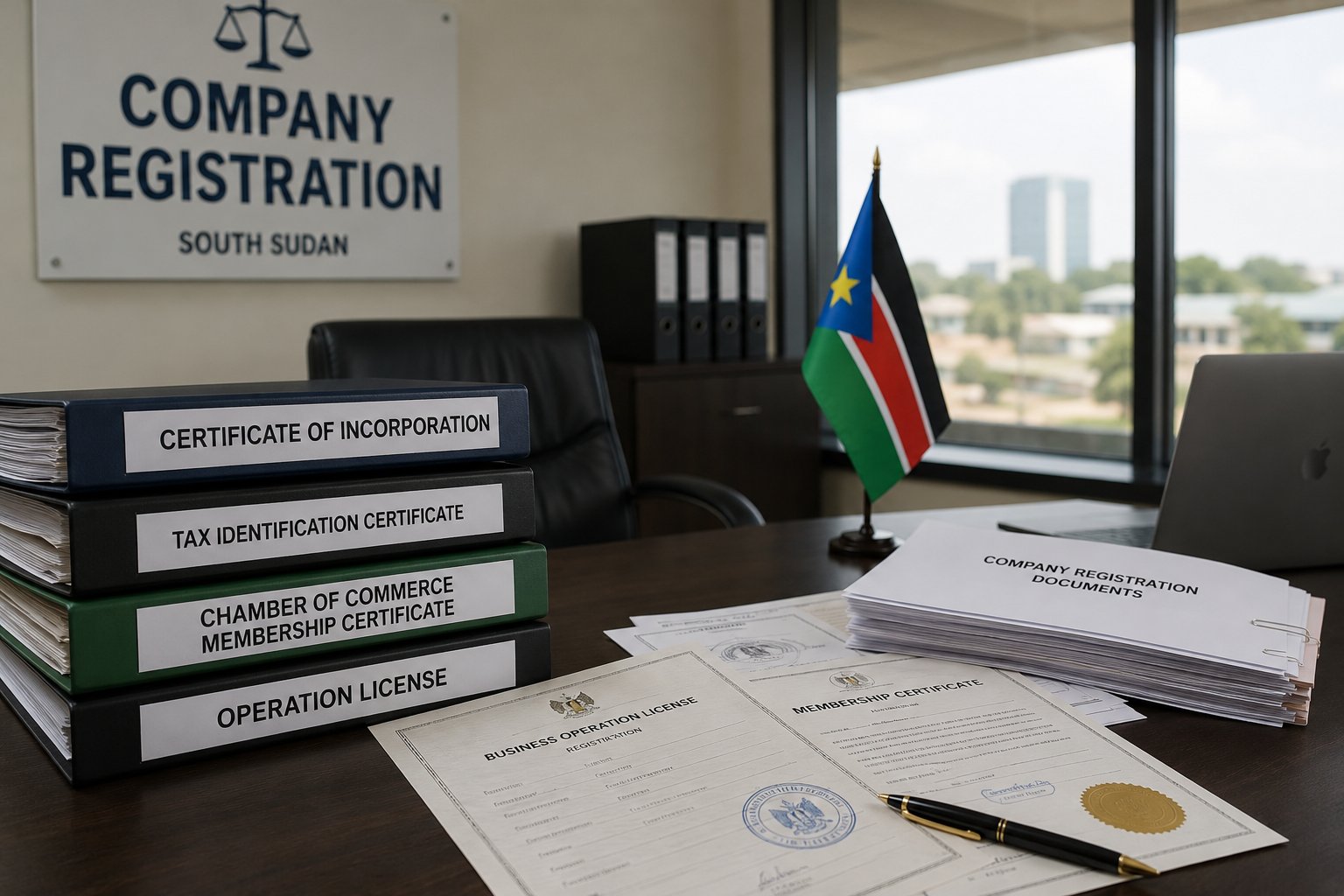
Foreign companies planning to enter the South Sudan market may consider registering a foreign branch as a practical route for establishing a legal business presence. A foreign branch allows a company incorporated outside South Sudan to operate locally without forming a separate South Sudanese subsidiary.
For international investors, contractors, service providers, and corporate groups, foreign branch registration in South Sudan can provide a direct structure for market entry, contracting, tax registration, and general business operations.
This guide explains the legal requirements, registration process, required documents, capital position, compliance obligations, and key risks involved in setting up a foreign branch in South Sudan.
What Is a Foreign Branch in South Sudan?
A foreign branch is a registered place of business of a company incorporated outside South Sudan.
The branch operates as an extension of the foreign parent company. It does not have separate legal personality from the parent company. This means the foreign parent company remains legally responsible for the obligations, liabilities, and activities of the South Sudan branch.
A foreign branch is often suitable where the foreign company wants to operate directly in South Sudan while maintaining its existing foreign corporate structure.
Foreign Branch vs Local Company in South Sudan
Before entering the South Sudan market, foreign investors should consider the most suitable legal structure. The common options include a local company, a foreign subsidiary, a company limited by guarantee, or a foreign branch.
| Business Structure |
Description |
Main Benefit |
Main Consideration |
| Private Company Limited by Shares |
A company incorporated in South Sudan with shareholders and separate legal personality. |
Strong local corporate presence. |
Local shareholding rules may be relevant depending on the business structure and activity. |
| Company Limited by Guarantee |
A structure commonly used for non-profit, association, or membership-based activities. |
Suitable for non-profit purposes. |
Usually not suitable for ordinary commercial business operations. |
| Foreign Subsidiary |
A South Sudan incorporated company owned by a foreign parent company or foreign shareholders. |
Separate legal personality from the foreign parent. |
Requires incorporation of a new local company. |
| Foreign Branch |
A registered place of business of a foreign company. |
No local shareholding requirement and direct continuity with the foreign parent company. |
The foreign parent remains responsible for branch obligations. |
For many foreign companies, foreign branch registration is attractive because it allows the company to maintain direct continuity with the parent company without creating a separate local entity.
Is Local Shareholding Required for a Foreign Branch in South Sudan?
No. A foreign branch does not require local shareholding in South Sudan.
This is one of the main advantages of foreign branch registration. Since the branch is an extension of the foreign parent company, it does not have separate shareholders in South Sudan.
This differs from a local company structure, where shareholding arrangements may need to be reviewed depending on the nature of the business and applicable regulatory requirements.
Is Registered Capital Required for a Foreign Branch in South Sudan?
For a foreign branch, the position is the same as for a local company in South Sudan. There is no registered capital requirement and no statutory time limit for capital contribution as a condition for registration.
A foreign branch is registered as a place of business of the foreign parent company. It is not incorporated as a new South Sudanese company with separate share capital.
The registration process therefore focuses on the legal existence of the foreign parent company, corporate authorization, appointment of a local representative, registered office address, and filing of the required documents.
Legal Basis for Foreign Company Registration in South Sudan
The Companies Act, 2012 provides the legal framework for foreign companies carrying on business in South Sudan.
A foreign company that has a place of business or carries on business in South Sudan is required to comply with the registration requirements applicable to foreign companies. These requirements generally include:
- Reserving the company name.
- Filing certified parent company documents.
- Filing particulars of directors and secretary.
- Appointing a local representative.
- Providing a registered office or place of business in South Sudan.
- Submitting the required application documents to the Business Registry.
Once the prescribed documents are submitted and accepted, the Registrar may register the foreign company and issue evidence of registration.
Branch Name Requirements in South Sudan
The branch name should normally correspond to the name of the foreign parent company, subject to reservation and approval by the Business Registry.
A common format is:
[Foreign Parent Company Name] – South Sudan Branch
The branch should also comply with applicable name display requirements. This may include displaying the company name and country of incorporation at its place of business and on official business correspondence.
Registered Office and Local Representative Requirements
A foreign branch must have a registered office or place of business in South Sudan. This address is used for official correspondence, regulatory notices, and service of documents.
The foreign company must also appoint one or more authorized persons resident in South Sudan to accept notices and service of process on behalf of the company.
There is no requirement that the branch manager or appointed representative must be a South Sudanese national. However, where the representative is a foreign national and will physically work in South Sudan, work permit and immigration compliance may be required, especially for tax registration and operational filings.
Documents Required to Register a Foreign Branch in South Sudan
The documents commonly required for foreign branch registration in South Sudan include:
- Certified true copy of the foreign parent company’s Certificate of Incorporation.
- Certified true copy of the Memorandum and Articles of Association, or equivalent constitutional documents.
- Board Resolution approving the registration of the branch in South Sudan.
- Power of Attorney or Memorandum of Appointment authorizing a representative in South Sudan.
- Particulars of directors and secretary of the foreign parent company.
- Passport copies or identification documents of directors or authorized representatives, where requested.
- Registered office or branch office address in South Sudan.
- Name reservation application.
- Foreign branch registration application forms.
Foreign-issued documents should generally be notarized, authenticated by the Ministry of Foreign Affairs in the country of origin, and legalized by the Embassy of the Republic of South Sudan or through the applicable authentication channel.
Where documents are not in English, certified translation may be required.
How to Register a Foreign Branch in South Sudan
The foreign branch registration process usually follows four main stages.
Step 1: Preliminary Legal Review and Document Preparation
The first step is to review the proposed business structure and confirm that foreign branch registration is the appropriate option.
At this stage, the legal team usually reviews the parent company documents, confirms the proposed branch name, prepares or reviews the Board Resolution, prepares or reviews the Power of Attorney, and confirms the details of the local representative and branch address.
Step 2: Name Reservation and Authentication of Foreign Documents
The proposed branch name is submitted for reservation with the Business Registry.
Foreign-issued documents are then prepared for certification, notarization, authentication, and legalization where applicable. Authentication costs may depend on the number of pages to be stamped, especially where the parent company’s constitutional documents are lengthy.
Step 3: Filing with the Business Registry
Once the file is complete, the foreign branch registration application is lodged with the Business Registry.
The Registrar may review the documents and request clarification or additional information. Once the application is accepted, the branch may be registered and issued with a registration certificate or equivalent confirmation.
Step 4: Post-Registration Compliance and Operational Readiness
After the branch is registered, the company should proceed with general post-registration compliance.
This may include obtaining:
- Operation Licence.
- Chamber of Commerce Membership Certificate.
- Tax Identification Certificate.
- Tax registration profile activation.
- Any other general business compliance documents required for ordinary operations.
These steps help ensure that the branch is ready for general business operations in South Sudan.
Additional Licences and Regulatory Approvals
Foreign branch registration gives the foreign company a general legal presence in South Sudan. However, branch registration does not automatically authorize activities that are regulated by a specific ministry, authority, commission, or sector regulator.
Where the proposed business activity falls within a regulated sector, the branch may need to obtain an additional licence, permit, approval, registration, or clearance from the relevant competent authority before commencing operations.
Foreign companies should review the exact scope of their intended activities before starting business in South Sudan. This helps confirm whether general branch registration is sufficient or whether further regulatory approvals are required.
Key Risks When Setting Up a Foreign Branch in South Sudan
Foreign companies should consider the following issues before registering a branch in South Sudan.
1. Different Parent Company Risk
A branch of one foreign company cannot be created by amending the existing branch of another foreign company. Where the parent company is different, a new foreign branch registration is required.
2. Regulatory Licensing Risk
Branch registration does not replace sector-specific licensing or regulatory approvals. Where the proposed activity is regulated under South Sudanese law or administrative practice, the branch should obtain the required licence, permit, approval, or clearance before commencing that activity.
3. Document Authentication Risk
Foreign-issued documents must be properly certified, notarized, authenticated, and legalized where required. The cost and timeline may increase depending on the number of pages requiring authentication.
4. Work Permit and Immigration Risk
Where the appointed representative or branch manager is a foreign national physically working in South Sudan, work permit and immigration compliance may be required.
5. Local Office and Service Address Risk
The branch must maintain a registered office and a resident person authorized to accept notices and service of process on behalf of the foreign company.
6. Post-Registration Compliance Risk
The branch should maintain annual filings and update the Registrar where there are changes to the parent company’s constitutional documents, directors, service representatives, registered office, or other prescribed particulars.
7. Tax Compliance Risk
Once registered and active, the branch will be expected to maintain tax registration and comply with applicable filing and payment obligations, even where operations are limited.
8. Contracting Risk
Contracts should clearly identify the foreign company operating through its South Sudan branch. Once the branch registration number is issued, it should be reflected in relevant business documents where appropriate.
Why Register a Foreign Branch in South Sudan?
Foreign branch registration may be suitable where a foreign company wants to:
- Establish a recognized legal presence in South Sudan.
- Operate through its existing foreign parent company.
- Avoid incorporating a separate South Sudanese subsidiary.
- Avoid local shareholding requirements applicable to certain local company structures.
- Register for tax and general business operations.
- Enter contracts through a registered South Sudan branch.
- Maintain continuity with the foreign parent company.
Conclusion
Foreign branch registration in South Sudan is a practical legal option for foreign companies seeking to establish a local business presence while continuing to operate through an existing foreign parent company.
A foreign branch does not require local shareholding or registered capital contribution in South Sudan. However, the branch must comply with registration requirements, maintain a local address and representative, obtain the required general operational documents, and assess whether any additional licence, permit, approval, or clearance is required for its intended business activities.
For foreign investors, the branch structure can provide a direct route to doing business in South Sudan, provided that company registration, tax, immigration, and regulatory compliance requirements are properly managed from the beginning.
Frequently Asked Questions
1. Can a foreign company register a branch in South Sudan?
Yes. A foreign company may register a branch in South Sudan, provided it complies with the applicable registration requirements for foreign companies.
2. Does a foreign branch need local shareholders in South Sudan?
No. A foreign branch does not require local shareholding because it is an extension of the foreign parent company.
3. Is registered capital required for a foreign branch in South Sudan?
No. There is no registered capital requirement and no statutory time limit for capital contribution as a condition for registering a foreign branch.
4. Does a foreign branch need a local office in South Sudan?
Yes. A foreign branch should have a registered office or place of business in South Sudan for official correspondence and service of notices.
5. Can a foreigner act as the branch representative?
Yes, but if the foreign representative will physically work in South Sudan, work permit and immigration compliance may be required.
6. Does branch registration cover all business activities?
No. Branch registration provides general legal presence. If the intended activity is regulated, additional licences, permits, approvals, registrations, or clearances may be required.
7. What documents are required to register a foreign branch in South Sudan?
The main documents usually include the parent company’s Certificate of Incorporation, constitutional documents, Board Resolution, Power of Attorney, directors’ particulars, local office address, and registration application forms.
Need Help with Foreign Branch Registration in South Sudan?
Legalline Law Chambers advises foreign investors, companies, and organizations on company registration, foreign branch registration, corporate structuring, regulatory compliance, licensing, tax registration, and post-registration advisory services in South Sudan.


 Corporate Law